Why Most Communication Problems Are Not Communication Problems
"...I blame communications. Must be a comms problem!" (politicians, executives, bosses)

You’ve heard this a zillion times. I have over the decades” “This is a comms problem! We have poor comms! Blame the p.r. folks!” When it’s all a dismissal of responsibility from performance and a misalignment with employee and audience expectations by giving them what you think they need because that’s what you need.
I see it today as events move faster than many organizations can manage and technology is flooding into workplaces like a turbulent tsunami. And so, I re-introduce the Triangle of Trust concept that I first published in my book back in 2007 and use in my Change Management university classes. Here’s how it looks:
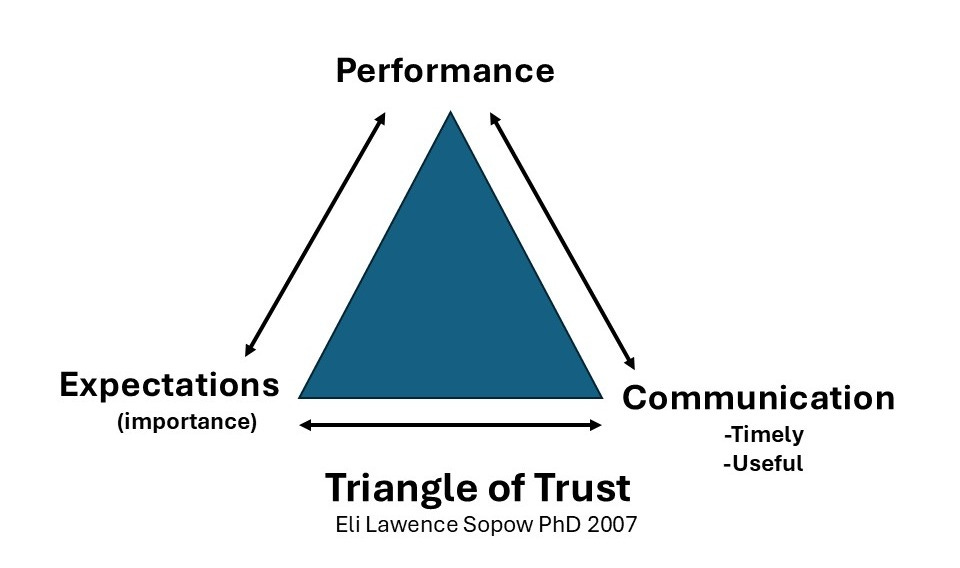
Here’s how you use the Triangle of Trust
Expectations: This is what employees, customers, stakeholders, regulators, and the public expect and consider important from your performance, meaning what you are doing, and giving/telling them. The needs can range from corporate culture to training, to behavior, to various systems. Expectations and their importance is usually a very situational thing, very often changing as societal values and workplace needs change.
Performance: This is what you are doing to meet expectations. It can be a function of resource levels, priorities, leadership, training, structure, systems, and continual internal/external environmental scanning to stay on top of the curve. Too often performance is based on what the giver thinks is important without validating with the receiver. Sometimes this misalignment is resistance to change.
Communication: This is usually the victim when things go wrong. Communication includes the techniques, culture, priorities, plus timeliness and usefulness of conveying messages and listening to others. We often rate communication the highest priority in workplaces but forget that trusted communication involves sincerity, honesty and timeliness. Employee research shows that employees can at once rate their communication as being useful, but because it’s too late that usefulness loses value.
Here’s how it all collapses and misaligns
Performance Gap: Performance is not matching expectations. What is promised is not delivered because of a lack of resources, leadership skill, structure, systems, and a failure to accurately read the changing environment. What is needed by the receiver is not understood by the giver who misunderstands the scene. Consequently, trust evaporates. This is NOT a Communication gap but a Performance gap.
Expectations gap: We se this especially today with the promise and hoopla of introducing advanced technology into the workplace. The expectations of what Large Language Models, friendly and supportive algorithms like Chat-GPT, and promises of magical efficiency have raised expectations and hopes to unreasonable levels. When Performance can’t meet hyped-up expectations it is not a Communication gap alone. It is an Expectations Gap. Performance may be perfectly acceptable. It is Expectations that need recalibration. Here Communication can be used in tandem with Performance to lower and moderate expectations or to ensure that expectations and performance are in alignment and mutally understood. Not easy, but necessary. But remember, Communication cannot permanently compensate for unrealistic expectations.
Communication gap: Here there are solely Communication gaps. I have seen this many times with organizations. It is when Performance is matching expectations. The receiver should be happy, but they think service is bad and trust is broken. The message of proficiency and efficacy is not getting through simply because of very poor communication strategy, tools, and implementation. This is where “comms is indeed the problem.”
So…what do you have? A Performance, Expectations, or Communication Gap? Do you meet expectations or lower expectations to be in alignment with Performance? Can you improve Performance to meet Expectations? And, are your Communications used to gloss over gaps with “spin doctoring” or actually helping an understanding of the possible?